
India’s airlines operated fewer routes during the peak Diwali travel season, signaling that rising costs and operational disruptions are beginning to cool momentum in one of the world’s fastest growing aviation markets.
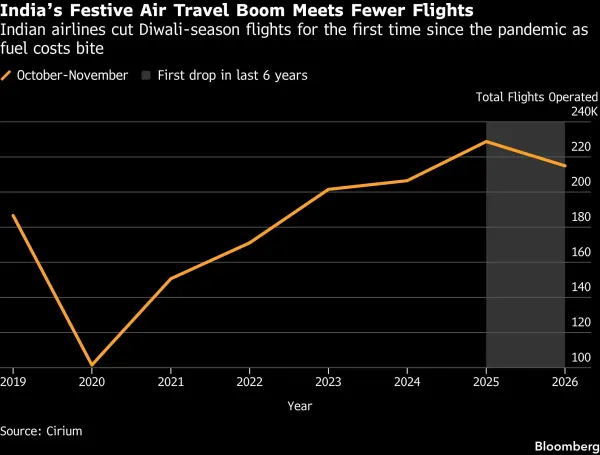
Airlines scheduled about 6% fewer flights across October and November than a year earlier, according to data from aviation analytics firm Cirium. That marks the first capacity decline since 2020, when carriers slashed service capacity by nearly 45% amid the pandemic-induced collapse in travel demand.
Also read | Air India shortlists former Singapore Airlines executive Balagopal Kunduvara for CFO role
The pullback comes as India’s aviation sector shows signs of strain as capacity reduction pushes fares up. While domestic passenger traffic had already declined 6.5% in September, festive-season fares on some routes surged to levels where one-way tickets cost as much as round-trip journeys did a year ago — putting air travel out of reach of consumers.
 Dinesh Sharma, a 28-year-old marketing professional in Hyderabad, said that despite booking his Diwali travel months in advance, he still couldn’t find an affordable ticket back home to Siliguri in the state of West Bengal.
“One-way fares had crossed Rs 20,000, roughly what I would normally pay for a round trip,” he said.
Also read | Australia's Qantas Airways to cut 850 jobs as AI takes off, back-office work shifts to India
Airlines say demand remains resilient but acknowledged passengers are bearing the burden of higher costs. Speaking on an earnings call last month, IndiGo Chief Executive Officer Willie Walsh said demand had held up “reasonably well,” while noting that airlines had to balance affordability with financial stability.
IndiGo, India’s largest carrier, reduced capacity by 1% and carried 4.5% fewer passengers during the quarter ended September. Despite a more than 34% increase in passenger yields, the airline reported a loss of 18.8 billion rupees during the period as its fuel bill jumped 67%.
The surge in fares reflects mounting pressure on airlines’ cost structures. Indian carriers are being squeezed by a combination of higher fuel prices, a weaker rupee and longer international flight paths caused by airspace restrictions, according to Ajay Prakash, chief executive of Mumbai-based travel agency Nomad Travels.
“Even though this is the festive season, I suppose it’s a question of surviving,” he said. Airlines have had to “rationalize their schedules, cut back wherever they can,” he said.
Airlines scheduled about 6% fewer flights across October and November than a year earlier, according to data from aviation analytics firm Cirium. That marks the first capacity decline since 2020, when carriers slashed service capacity by nearly 45% amid the pandemic-induced collapse in travel demand.
Also read | Air India shortlists former Singapore Airlines executive Balagopal Kunduvara for CFO role
The pullback comes as India’s aviation sector shows signs of strain as capacity reduction pushes fares up. While domestic passenger traffic had already declined 6.5% in September, festive-season fares on some routes surged to levels where one-way tickets cost as much as round-trip journeys did a year ago — putting air travel out of reach of consumers.
“One-way fares had crossed Rs 20,000, roughly what I would normally pay for a round trip,” he said.
Also read | Australia's Qantas Airways to cut 850 jobs as AI takes off, back-office work shifts to India
Airlines say demand remains resilient but acknowledged passengers are bearing the burden of higher costs. Speaking on an earnings call last month, IndiGo Chief Executive Officer Willie Walsh said demand had held up “reasonably well,” while noting that airlines had to balance affordability with financial stability.
IndiGo, India’s largest carrier, reduced capacity by 1% and carried 4.5% fewer passengers during the quarter ended September. Despite a more than 34% increase in passenger yields, the airline reported a loss of 18.8 billion rupees during the period as its fuel bill jumped 67%.
The surge in fares reflects mounting pressure on airlines’ cost structures. Indian carriers are being squeezed by a combination of higher fuel prices, a weaker rupee and longer international flight paths caused by airspace restrictions, according to Ajay Prakash, chief executive of Mumbai-based travel agency Nomad Travels.
“Even though this is the festive season, I suppose it’s a question of surviving,” he said. Airlines have had to “rationalize their schedules, cut back wherever they can,” he said.