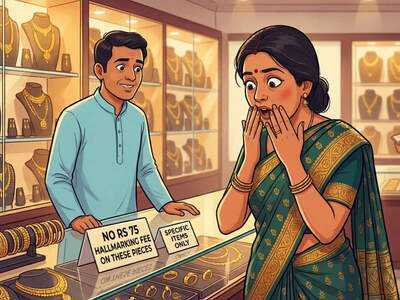
No hallmarking fee for these jewellery items
Gold goes beyond being just a metal or a piece of jewellery in India. It holds a rather emotional sanctity in Indian households. To protect this, the Bureau of Indian Standards (BIS) had made hallmarking for gold jewellery mandatory on June 16, 2021. This is a flat fee levied on each gold article, irrespective of its weight.
However, there are still certain gold jewellery pieces that are exempt from the current framework. This means that applies to these pieces of jewellery. The BIS levies a gold hallmarking fee of Rs 75 per article (excluding GST), from September 14, 2026.
So, don’t end up paying the fee if you buy any of the exempt gold jewellery articles this Dhanteras or Diwali. Here's a look at the types of gold jewellery and artefacts that are not mandatorily required to be hallmarked by jewellers.
No gold hallmarking fee on these items
According to the Bureau of Indian Standards, key exemptions under the current mandatory gold hallmarking framework include the following:
Many jewellery pieces include two or more parts which may be joined together, like in earrings or necklaces. For such articles, the BIS says that buyers should ensure that each article in a pair and all detachable parts should be hallmarked with different HUIDs.
A detachable part of jewellery is any part which can be easily removed or replaced. BIS states that each article in a pair and all detachable parts should have a hallmark with different HUIDs. Customers should look for hallmarking and fineness details in each article to prevent any misuse w.r.t fineness/purity.
What if the detachable part in gold jewellery weighs less than 2 grams?
Let’s understand this with an example. Assume that you are buying a pair of gold earrings this Dhanteras. Now, let’s say that the earring screw is also made of gold, but it weighs less than 2 grams. As per BIS guidelines, the jeweller will hallmark the front side of the gold earrings if they weigh more than 2 grams.
And the earring screw will not be hallmarked since it doesn’t weigh more than 2 grams.
Gold hallmarking fee in 2026
The BIS revised the hallmarking charges applicable to gold and silver articles in September 2026, just ahead of the festive season.
Now, jewellers will have to shell out Rs 75 per gold article to a recognised Assaying and Hallmarking centre. Earlier, the price was Rs 45, translating into a jump of nearly 67%. Note that a minimum fee of Rs 200 per consignment will apply, as per the official notification.
ALSO READ |
Are hallmark charges added to your total bill?
Yes, jewellers add the fee to your final bill. This is the formula that jewellers typically use to calculate the final price of a piece of jewellery:
Total = [(Net weight × Day's rate × Purity) + Making charges + Wastage] × 1.03 + Hallmarking fee
It is worth mentioning here that the hallmark will be valid for the entire lifetime of the gold jewellery.
However, there are still certain gold jewellery pieces that are exempt from the current framework. This means that applies to these pieces of jewellery. The BIS levies a gold hallmarking fee of Rs 75 per article (excluding GST), from September 14, 2026.
So, don’t end up paying the fee if you buy any of the exempt gold jewellery articles this Dhanteras or Diwali. Here's a look at the types of gold jewellery and artefacts that are not mandatorily required to be hallmarked by jewellers.
No gold hallmarking fee on these items
According to the Bureau of Indian Standards, key exemptions under the current mandatory gold hallmarking framework include the following:
- Gold articles below 2 grams
- Kundan/Polki/Jadau articles
- any article meant for export, which conforms to any specification required by the foreign buyer
- any article intended to be used for medical, dental, veterinary, scientific or industrial purposesany article of gold thread
- any manufactured article which is not substantially complete, and is intended for further manufacture
- gold bullion in any shape of bar, plate, sheet, foil, rod, wire, strip, tube or coin
- jewellery for International Exhibitions
- jewellery for domestic Business-to-Business exhibitions
- gold watch and fountain pen
Many jewellery pieces include two or more parts which may be joined together, like in earrings or necklaces. For such articles, the BIS says that buyers should ensure that each article in a pair and all detachable parts should be hallmarked with different HUIDs.
A detachable part of jewellery is any part which can be easily removed or replaced. BIS states that each article in a pair and all detachable parts should have a hallmark with different HUIDs. Customers should look for hallmarking and fineness details in each article to prevent any misuse w.r.t fineness/purity.
What if the detachable part in gold jewellery weighs less than 2 grams?
Let’s understand this with an example. Assume that you are buying a pair of gold earrings this Dhanteras. Now, let’s say that the earring screw is also made of gold, but it weighs less than 2 grams. As per BIS guidelines, the jeweller will hallmark the front side of the gold earrings if they weigh more than 2 grams.
And the earring screw will not be hallmarked since it doesn’t weigh more than 2 grams.
Gold hallmarking fee in 2026
The BIS revised the hallmarking charges applicable to gold and silver articles in September 2026, just ahead of the festive season.
Now, jewellers will have to shell out Rs 75 per gold article to a recognised Assaying and Hallmarking centre. Earlier, the price was Rs 45, translating into a jump of nearly 67%. Note that a minimum fee of Rs 200 per consignment will apply, as per the official notification.
ALSO READ |
Are hallmark charges added to your total bill?
Yes, jewellers add the fee to your final bill. This is the formula that jewellers typically use to calculate the final price of a piece of jewellery:
Total = [(Net weight × Day's rate × Purity) + Making charges + Wastage] × 1.03 + Hallmarking fee
It is worth mentioning here that the hallmark will be valid for the entire lifetime of the gold jewellery.
Contact to : xlf550402@gmail.com
Copyright © boyuanhulian 2020 - 2023. All Right Reserved.