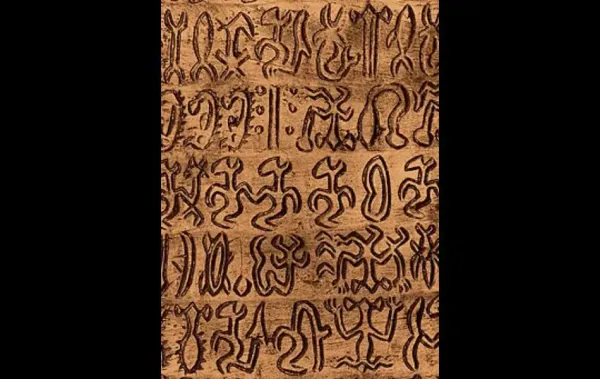
For more than 150 years, researchers have tried to understand the strange symbols carved into wooden tablets on Easter Island. Known as rongorongo, the script has resisted every attempt to decipher it. A new study has offered a fresh clue about its history. One tablet contains wood dating to the 15th century, more than 200 years before Europeans first arrived on the island.
The finding raises the possibility that the people of Rapa Nui developed their own writing system without European influence.
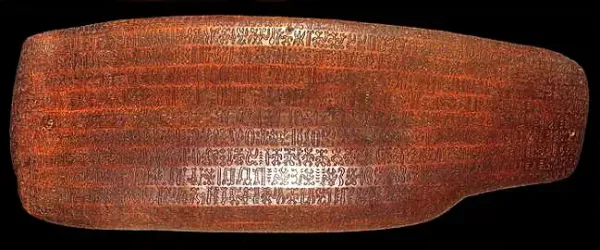
The rongorongo script consists of intricate glyphs carved into wooden objects. Europeans first took note of the writing in the 19th century. In 1864, missionary Eugene Eyraud described wooden tablets and staffs covered with what he called “sorts of hieroglyphic characters.”
Today, only about two dozen objects bearing the script survive, and none remain on the island itself. The artifacts are held in collections around the world.
Researchers have identified more than 400 different glyphs among roughly 15,000 surviving characters. Yet no one has managed to establish what the symbols mean or how they should be read.
As Alexander Lee wrote for History Today, researchers still do not know exactly what kind of script rongorongo represents. It could be an early form of writing or a fully developed system. The symbols might represent pictures or they could serve as memory cues. This uncertainty has made rongorongo one of the most intriguing mysteries in the study of ancient writing.
The fourth produced a much older result. The wood dated to between 1493 and 1509, placing it more than two centuries before the first recorded European arrival on Rapa Nui in the 1720s.
Ferrara told Live Science that the finding supports the idea that the islanders developed rongorongo independently.
“Historically speaking, if you borrow a writing system, then you keep it as close to the original as possible,” she said.
The glyphs also look very different from European letters, adding to the argument that the script may have originated on the island.
There is one important limitation, however. The age of the wood does not prove exactly when the symbols were carved. The tablet could have been made using an old piece of wood. Ferrara considers that explanation unlikely because it would mean the material had been stored for more than 200 years.
Researchers also believe the wood came from a tree species not native to Rapa Nui, possibly making it driftwood.
Wieczorek believes the script could be one of the few writing systems invented independently in human history.
“I actually believe that rongorongo is one of the very few independent inventions of writing in human history, like the writing of the Sumerians, the Egyptians and the Chinese,” he said. “But belief is a different thing than hard data … so ideally, we would like to test all the tablets.”
The mystery may take years to solve. But by establishing a possible early date for one tablet, researchers have gained a new starting point for investigating a script that has remained unreadable for more than a century and a half. The information is taken from Live Science and Smithsonian Magazine.
The finding raises the possibility that the people of Rapa Nui developed their own writing system without European influence.
In the 19th century, mysterious glyphs from Easter Island drew scholarly attention; more than 150 years later, the Rongorongo script remains undeciphered [Image credit: Wikiepdia]
Easter Island’s Rongorongo Script Is So Mysterious
Rapa Nui, also known as Easter Island is famous for its enormous stone statues called moai and Rapa Nui draws visitors who want to see the moai close. But its wooden tablets carry another mystery that has puzzled researchers for generations.The rongorongo script consists of intricate glyphs carved into wooden objects. Europeans first took note of the writing in the 19th century. In 1864, missionary Eugene Eyraud described wooden tablets and staffs covered with what he called “sorts of hieroglyphic characters.”
Today, only about two dozen objects bearing the script survive, and none remain on the island itself. The artifacts are held in collections around the world.
Researchers have identified more than 400 different glyphs among roughly 15,000 surviving characters. Yet no one has managed to establish what the symbols mean or how they should be read.
As Alexander Lee wrote for History Today, researchers still do not know exactly what kind of script rongorongo represents. It could be an early form of writing or a fully developed system. The symbols might represent pictures or they could serve as memory cues. This uncertainty has made rongorongo one of the most intriguing mysteries in the study of ancient writing.
Could Rongorongo Have Been Invented Without European Influence?
A study published in Scientific Reports offers new evidence about when the script may have emerged. Researchers led by Silvia Ferrara, a philologist at the University of Bologna in Italy, examined four rongorongo tablets preserved by a Catholic congregation in Rome. Radiocarbon testing showed that three were made from trees felled in the 18th or 19th centuries.The fourth produced a much older result. The wood dated to between 1493 and 1509, placing it more than two centuries before the first recorded European arrival on Rapa Nui in the 1720s.
Ferrara told Live Science that the finding supports the idea that the islanders developed rongorongo independently.
“Historically speaking, if you borrow a writing system, then you keep it as close to the original as possible,” she said.
The glyphs also look very different from European letters, adding to the argument that the script may have originated on the island.
There is one important limitation, however. The age of the wood does not prove exactly when the symbols were carved. The tablet could have been made using an old piece of wood. Ferrara considers that explanation unlikely because it would mean the material had been stored for more than 200 years.
Researchers also believe the wood came from a tree species not native to Rapa Nui, possibly making it driftwood.
Why Has the Script Still Not Been Deciphered?
The new findings do not reveal what the glyphs say. Instead, they provide evidence that could help researchers understand how the writing system developed. Rafal Wieczorek, a chemist at the University of Warsaw who was not involved in the study, called the research “a great development.” He noted that only two rongorongo tablets had previously been radiocarbon-dated.Wieczorek believes the script could be one of the few writing systems invented independently in human history.
“I actually believe that rongorongo is one of the very few independent inventions of writing in human history, like the writing of the Sumerians, the Egyptians and the Chinese,” he said. “But belief is a different thing than hard data … so ideally, we would like to test all the tablets.”
The mystery may take years to solve. But by establishing a possible early date for one tablet, researchers have gained a new starting point for investigating a script that has remained unreadable for more than a century and a half. The information is taken from Live Science and Smithsonian Magazine.