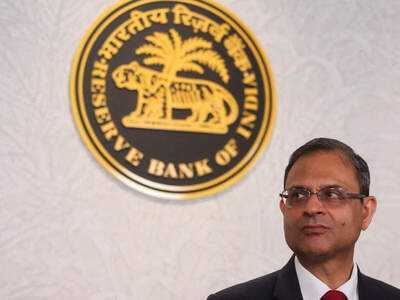
Speaking at the 5th in New Delhi, Reserve Bank of India (RBI) Governor warned that financial stress can build overnight but take years to resolve, and that India cannot afford to become complacent.
He said the system has absorbed the shock quite well and growth has been resilient. But the conflict has added to inflationary pressures and raised financial system vulnerabilities, he said, at a time when a fragmenting global order makes risks harder to predict and model.
"We cannot afford to become complacent," he said. "The economic and financial costs of allowing vulnerabilities to build are simply too high."
Malhotra said he does not see any imminent signs of stress, but the system must remain alert to risks. He said the past two decades show that banking and financial stress can build quickly but take years to resolve. He said it took more than a decade to clean up the legacy of excessive lending and non-performing assets (NPAs) from the early 2000s.
A changing global order
The Governor said the international order that emerged after the Washington consensus is under considerable strain. That order gave decades of globalisation, economic integration and relative stability.
He listed geopolitical and geo-economic fragmentation, strategic realignment, trade restrictions, repeated supply shocks, technological disruption and climate change. These factors are interacting in ways that are hard to predict and even harder to model using historical relationships, he said.
Price and cannot be looked at in isolation from these developments, he added.
Malhotra said the RBI Act, 1934 does not give the central bank an explicit mandate for financial stability. But he said it is implicit in the functions assigned to the RBI. The preamble of the Act gives the RBI responsibility for monetary stability as well as price stability. The Foreign Exchange Management Act (FEMA), 1999 provides for the orderly development and maintenance of the forex market.
The RBI regulates banks and non-banking financial companies (NBFCs). It also regulates payment systems, acts as lender of last resort and runs deposit insurance. He said this gives the RBI the view, mandate, capability and tools to assess emerging vulnerabilities and take timely corrective action.
"Financial stability is the foundation on which price stability rests," Malhotra said. He added that it is essential for effective transmission of . The full potential of cannot be reached without a stable and healthy financial system, he said.
Malhotra pointed to the Financial Stability and Development Council (FSDC) as the institutional mechanism for financial stability. The Finance Minister heads the FSDC. It includes all financial sector regulators and members from the government. Its role is to exchange information and coordinate policy actions.
Focus on resilience
The Governor said no one can prevent every shock, whether it comes from the real economy, a geopolitical event, a commodity price spike or technological disruption. What can be ensured is that the financial system acts as a shock absorber, he said.
He said the RBI's focus over the years has been to improve the resilience of the financial system. It does this through prudent regulation, risk-based supervision, macroprudential measures and liquidity support, including emergency liquidity assistance. The final tool is resolution.
Balancing risk and growth
Malhotra said regulations aim to build a financial system that is well capitalised, liquid and well governed, so that it can manage and absorb shocks. At the same time, he said, trying to remove all risks would curtail innovation and investment. Regulations therefore try to strike the right balance between risk management and support for economic growth, he said.
On supervision, the Governor said the RBI has a well-developed system of both off-site and on-site supervision. He said the central bank is increasingly using modern tools such as data analytics, technology-enabled surveillance and thematic assessments. These help identify emerging risks and vulnerabilities at an early stage, he said.
Contact to : xlf550402@gmail.com
Copyright © boyuanhulian 2020 - 2023. All Right Reserved.