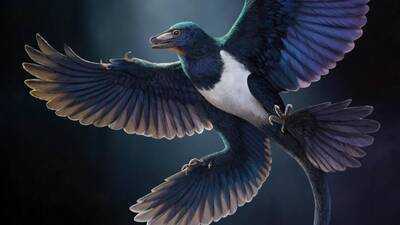
For a long time, textbooks made dinosaur flight look like a neat progression: feathers show up in small theropod dinosaurs, wings evolve, birds emerge, and off they go. But life doesn’t organize itself that cleanly. A newly discovered dinosaur fossil from northeastern China, the remarkably preserved Norellraptor barsboldi , is challenging the basics of how flight evolved among bird relatives.
This little predator was only 57 centimetres (about 22 inches) long, but its skeleton, which is almost entirely intact, tells an outsized story. It had feathers and skeletal tweaks suggesting it was built for aerial movement. Scientists think this fossil adds even more weight to the idea that flight-related traits popped up separately in different groups, not as some single blueprint. Their peer-reviewed study landed in in September 2026.
Who was Norellraptor Barsboldi?This tiny dinosaur lived during the Early Cretaceous, as a member of the microraptorines, which are feathered carnivores closely related to birds (but not their direct ancestors). It was found near Lamadong Town, Jianchang County, western Liaoning. A farmer dug it up in 2023 and handed it over to Hebei GEO University’s museum. The specimen’s preservation is outstanding; most bones are undisturbed, and some feather traces remain visible.
Norellraptor lived in what’s called the Jiufotang Formation, part of a fossil-rich region that has changed everything we knew about dinosaur feathers and the bird transition. This area showed us that feathered dinosaurs were common; birds didn’t start the trend alone.
Interestingly, Norellraptor was something of a teenager when it died—bone evidence points to about three years old. It was tiny, just over half a meter.
Feathers, wings, and four surfaces for flightMicroraptorines have fascinated scientists for years. Unlike classic bird wings, some had long flight feathers on both the forelimbs and hindlimbs, basically creating four “wings.” This sparked debates: could they really fly, glide, or just maneuver in trees?
The Norellraptor fossil tweaks that debate some more. The team found robust forelimb bones, an extended ulna, and rib changes for a stronger torso — all clues hinting at aerial capability. These aren’t carbon copies of bird anatomy, but some elements are strikingly similar, enough to raise big questions.
Did birds and microraptors learn to fly separately?When researchers compared microraptorine evolution with early birds (Avialae), they found about 30% of flight-related anatomical changes were shared. Same features, different order: that’s hugely important. It suggests these two groups didn’t inherit flight abilities from a common ancestor, but instead stumbled onto similar innovations by themselves.
So, flight likely evolved a few times, separately, among bird-like dinos. This fossil says evolution doesn’t always repeat the exact same steps.
Not a bird, but a fierce little predatorThere’s a habit of calling anything feathered a “bird,” but microraptors weren’t. They were feathered theropods, and that tells us clever feathers evolved long before modern birds arrived.
Chinese feathered dinosaur finds have already proved feathers appeared among predatory dinosaurs early, gradually morphing into the sophisticated ones we see in today’s birds. Norellraptor fits right into a world of evolutionary trial and error.
What was on its menu?Despite its bird-ish look, Norellraptor was pretty ruthless. It had sharply curved teeth and claws, which indicates that it was definitely a meat-eater. Likely, it hunted small vertebrates: lizards, early mammals, frogs, maybe even baby dinosaurs. It wouldn’t be taking on T. rex, but smaller prey was fair game. It probably used its aerial skills to zip through forests, dodge predators, or chase food, though scientists still debate exactly how microraptorines flew.
Why does this fossil matter?Norellraptor doesn’t rewrite the story of birds’ dinosaur ancestry; it makes it more interesting. Instead of a single straight path from feathered dino to flying bird, the evidence now points to multiple, messy evolutionary experiments. Feathers, limbs, and aerodynamic tweaks cropped up in several lineages, often independently.
That’s part of what makes this little fossil so intriguing. About 120 million years ago, evolution was already playing with wings, not just in one group, but in several. Norellraptor barsboldi isn’t just another step toward birds; rather, it’s proof that evolution loves to tinker, and sometimes, it tries the same idea in more than one way.
Contact to : xlf550402@gmail.com
Copyright © boyuanhulian 2020 - 2023. All Right Reserved.