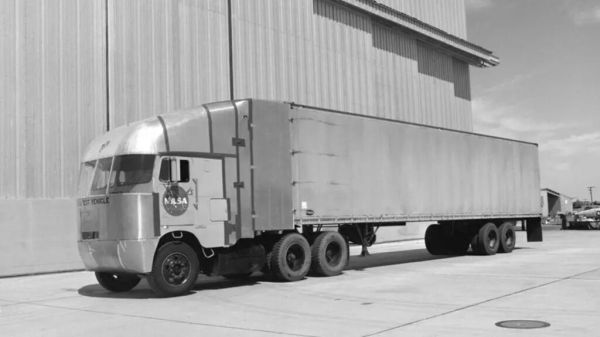
Throughout their history, semi-trucks have undergone many design changes in an attempt to be more aerodynamic and fuel-efficient, especially when emissions regulations became stricter during the oil crisis of the 1970s. Since then, engineers have kept finding ways to make trucks more aerodynamic without limiting carrying capacity — and a lot of those designs are inspired by NASA’s research on vehicle aerodynamics.
The story goes that Aerospace Engineer Edwin J. Saltzman was on a bicycle in 1973 when he noticed large trucks on the highway would push and pull him as they drove by. After experiencing this, Saltzman wondered whether there was a way to make trucks “glide through the air” rather than push their way through it, allowing for less drag and less gas consumption (via NASA).
The engineering team at the Dryden Flight Research Center reshaped a Ford van by rounding out its corners and sealing the bottom and found it reduced drag by 59%. The team continued testing and changing the truck’s shape to further reduce drag, such as closing the gap between the cab and trailer and adding a boat tail. At this point, they found that a trucker driving 100,000 miles a year could save as much as 6,829 gallons annually with these changes.
How NASA’s truck research is implemented in present day
NASA’s decades of research transformed semi-truck design, with many manufacturers adopting different elements from the NASA engineers’ experiments to create more aerodynamic cabs with rounded corners and edges. NASA noted: “Nearly all trucks on the road have been shaped by NASA — literally.”
However, there hasn’t been a lot of change with trailers due to the stubbornness of the livestock industry, and commercial truckers need the trailer’s back end to be flat for loading-dock purposes. That is why you haven’t seen the boat tail design on the highway, despite its significant drag reduction. You still see a gap between the cab and trailer on modern semi-trucks, but side extenders have been added to reduce the gap size.
There have been a few instances where companies attempted to emulate NASA’s research, including Thomas Scott Breidenbach’s 2006 invention, the TrailerTail. This stuck out behind the trailer, similar to a boat-tail shape, and its lightweight design allowed for improved fuel economy. However, it was tricky to get this universally implemented as gas prices continued to fluctuate. More commonly, you’ll see semi-trucks with side skirts, which replicate the sealed bottom of those early NASA experiments by lowering wind resistance. UnderTray systems are also starting to appear on semi-trucks to further reduce drag.
Due to the stubbornness of semi-truck trailer designs, NASA has also introduced a new product, Airtabs, which create the same kind of aerodynamic airflow as a boat tail. The triangular shape shifts the usual airflow pattern on larger vehicles, allowing it to taper at the rear. According to NASAAirtabs also improve vehicle stability and reduce fishtailing for those with trailers.