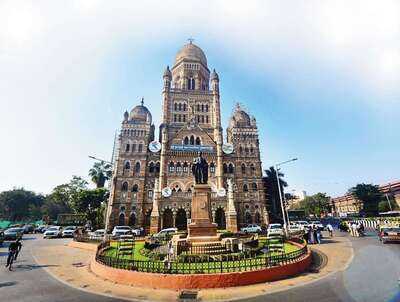
Mumbai: Nearly three months after Maharashtra chief minister Devendra Fadnavis announced in the state assembly a Rs 13,000 crore integrated flood control master plan to tackle Mumbai’s chronic flooding problem, mainly in low-lying areas, BMC has drawn up a Rs 7 ,345.9 crore plan to be implemented under Urban Flood Risk Management Programme (UFRMP).
Additional municipal commissioner Abhijit Bangar confirmed that the Rs 13,000 crore project outlay includes taxes as well as three projects already underway — Mogra and Mahul pumping stations and Mithi rejuvenation works.
Bangar said 40% of the total project cost will be funded by Centre. The project, being undertaken under the guidance of National Disaster Management Authority (NDMA) and Maharashtra govt, will include nature-based flood mitigation measures, stormwater drainage augmentation, pumping stations, nullah widening, automated flood-protection gates and coastal embankments.
BMC has proposed appointing consultants to prepare detailed designs and detailed project reports (DPRs) for the works. The consultancy is estimated to cost about Rs 110.2 crore.
The proposed works have been divided into three packages. Package P1, estimated at Rs 2,194 crore, focuses on nature-based solutions and stormwater management infrastructure. It includes bio-retention systems and bioswales, urban sponge parks and green corridors, permeable pavements, detention-cum-infiltration tanks, retention/detention basins and drainage-network protection and flow enhancement.
Package P2, estimated at Rs 2,142.5 crore, comprises automated flood protection gates and coastal embankments.
The largest package, P3, is estimated at Rs 3,009.35 crore and includes a new stormwater management and pumping station at Andheri subway, estimated at Rs 500 crore, along with Rs 2,509.9 crore for augmentation of nallas across the eastern suburbs, western suburbs and city area to ensure that stormwater reaches pumping stations or natural water bodies.
The DPR consultants will undertake detailed surveys, investigations, hydraulic and hydrological assessments, engineering designs, cost estimates and implementation plans before the projects are taken up.
For Package P1, the proposed studies include high-precision topographical surveys using drones, Total Station and DGPS, hydrological surveys, geotechnical investigations, groundwater monitoring and, wherever required, bathymetric surveys. The consultants will also assess soil permeability and infiltration rates to determine the design of infiltration tanks, bio-retention systems and permeable pavements. For P3, the consultants will assess flood profiles, drainage capacities and tidal backflow at outfall points. BMC plans to use flow meters, Acoustic Doppler Current Profilers (ADCPs) and other techniques to determine catchment-wise inflows and establish the required capacity of the Andheri pumping station and augmented nallas.
The project document states that Mumbai receives around 2,500 mm of rainfall annually and faces a combination of intense rainfall, high tides, storm surges, low-lying reclaimed land, shrinking natural drainage channels and increasing impervious surfaces. The proposed flood-management programme also envisages the use of digital twin technology, GIS, remote sensing, IoT-based monitoring, SCADA, artificial intelligence and decision-support systems, along with climate-resilient planning and nature-based solutions. The programme is intended to reduce flood-related damage, improve the capacity of Mumbai’s drainage network, strengthen coastal and tidal flood protection and improve flood forecasting, early warning and emergency response systems.
Officials said that the blueprint has been in the works for over a year, with the first NDMA meeting held on March 12, 2025, followed by site visits and a presentation to Union home minister Amit Shah in June this year, after which it received in-principle clearance.
Contact to : xlf550402@gmail.com
Copyright © boyuanhulian 2020 - 2023. All Right Reserved.