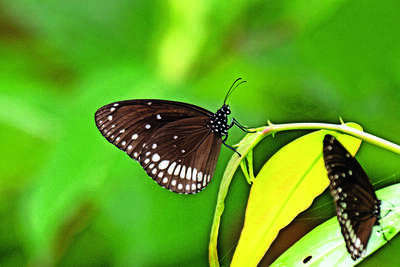
Leading a butterfly walk at Pachamalai hillock in Chennai recently, nature educator Claudia Pinheiro noticed more butterflies than usual turning up on the trail. Claudia, a member of Palluyir Trust for Nature Education and Research, which has been running these walks across the city for the past few months. She says this isn’t the only spot seeing a spike. In Chennai, places such as Siruseri, Theosophical Society in Adyar and north Chennai too are seeing larger numbers of butterflies.
If you’ve come across a swarm of butterflies recently that seemed to be going somewhere, and not just resting on a plant, you could have been witnessing the annual migration of that species.
“The real surprise in Chennai has been the spotting of the painted lady in unusually large numbers. The butterfly is associated with the Western Ghats ,” says Claudia. The painted lady, she says, is known as one of the world’s longest-distance migrating butterflies, covering 15,000km in some parts of its range. “It is distributed across different regions and is known to migrate between Africa and Europe as well.”
A 2023 paper published in the Journal of Insect Conservation says, “A huge number of danaine butterflies undertake seasonal migration between the eastern plains and the Western Ghats in Southern India” every year. “They cover the 400km in about a week, says M A Yathumon , one of the authors. “However, they do not travel the entire distance in one stretch but stop at various locations along the way. Large numbers have been recorded congregating in Bengaluru and parts of the Eastern Ghats.”
In South India, the westward movement generally takes place around Oct and Nov, sometimes beginning as early as Sept. The eastward migration occurs around March, April and May.
While migration patterns of birds are much discussed those of butterflies, though important for maintaining biodiversity, remains understudied in India. “The movement between Western Ghats and eastern plains might be the largest butterfly migration system in India, but has received little research and attention, posing a challenge for their effective conservation and management,” says the paper.
“During our walks, we also noticed many butterflies in their early stages, particularly caterpillars. This indicates that the butterflies that have arrived from the Western Ghats are using these areas for breeding and feeding,” says Claudia.
But why do butterflies migrate? The reason is not yet understood, says Yathumon. “Worldwide, several butterfly species migrate. The best-known example is the monarch butterfly, which migrates to escape harsh climatic conditions in North America. It moves south towards Mexico, where the winter is comparatively milder. In South India, we see species that belong to the same subfamily as monarchs. Their migration has several similarities, but we cannot say with certainty that they migrate to escape extreme climatic conditions, because the climate here is not as extreme.”
One hypothesis is that they migrate to escape the monsoons, while another says migration helps butterflies make use of resources available in different regions. “Certain resources may be limited in one area but abundant in another,” says Yathumon. Butterflies depend on specific plants on which they lay their eggs and on which their caterpillars feed, called larval host plants. The distribution of these plants could influence migration. “There are plants such as crotalaria that contain alkaloids needed by the butterflies. These plants are more diverse in the Western Ghats,” says Yathumon.
Like most other insect species, butterflies too face threats today, especially the destruction of the habitat of their larval host plants, inside and outside forests. Other concerns include pesticide use and traffic. “During migration, many butterflies are killed after being hit by speeding vehicles, something we have recorded repeatedly during our studies,” says Yathumon. The spread and establishment of invasive plants is yet another threat to butterfly habitats and larval host plants, while climate change-driven extinctions of butterfly species are also widespread.
Big moves
Migration in South India is not restricted to one species but involves a group of butterflies belonging to the subfamily danainae. They are commonly called milkweed butterflies because their caterpillars feed on plants containing milky latex.
The major migratory species recorded in the study is the dark blue tiger. Other species include the blue tiger, double-branded crow, common crow and striped tiger. Species composition varies between locations. In Maharashtra and the northern Western Ghats, striped tigers are more common, while in southern India, dark blue tigers and double-branded crows are more frequently observed.
Spreading their wings
· The earliest records of butterfly movements date back to around 1900, when documented by the British
· Studies suggest that the migrating butterflies are breeding alternately in the Western Ghats and the eastern plains. Hence, it is considered that their progeny undertakes the reverse migration
~ Butterflies act as long-distance pollinators and help to maintain biodiversity. Shifts in migratory timing can help scientists monitor climate change and habitat loss
· Danaine butterflies congregate in large clusters in shady places within the forests during the dry season. Observations from the Western Ghats show that hundreds of thousands of butterflies are found in such congregations and they remain in these sites for several months
~ Butterflies generally fly at a height of about one to five metres, so they can be observed relatively easily
Contact to : xlf550402@gmail.com
Copyright © boyuanhulian 2020 - 2023. All Right Reserved.