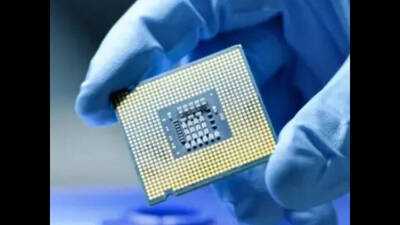
The Bengaluru brains behind Intel's global chips
Nearly two decades ago, Intel’s engineers in Bengaluru helped put six processing cores onto a single piece of silicon. The result was Dunnington, a chip launched in 2008 for the powerful servers that run business applications. Today, the work coming out of India reaches into processors designed to put AI inside laptops, with engineers helping decide how much those machines can do without draining their batteries.
That range of work has made India an important engineering base for the semiconductor company. Its centre here contributes to the circuits inside a processor, the software that makes it useful, and the computer around it. Panther Lake, Intel’s family of AI PC processors, brings those capabilities together.
“We are doing the most advanced engineering for that manufacturing node out of Intel India , even though we don’t have the fab (fabrication plant) here,” says Gokul Subramaniam, Intel India president and VP of the client computing group.
Panther Lake uses Intel’s advanced 18A (1.8-nanometer process node) manufacturing technology for its main computing section. A process node, as such technology generations are called, determines how engineers can build and connect the tiny electronic switches inside a chip.
India’s contribution includes work on the CPU cores, the engines that execute a computer’s instructions, along with graphics and other circuit components. Engineers also worked with the design libraries used to turn the new manufacturing process into working chips.
“We worked with the 18A libraries to mature the 18A process as we used it for Panther Lake,” Subramaniam says. Libraries here are collections of circuit building blocks suited to a particular manufacturing technology. Using them in a complex processor helps connect what a factory can manufacture with what chip designers need.
The new 18A manufacturing process tackles a basic problem: how to fit more computing power into a chip without wasting electricity. Chips contain billions of transistors, tiny switches that control electrical current to process information. Each has a “gate” that regulates this flow. Intel’s new design wraps the gate around the path carrying the current, giving it better control as the switches become smaller. That allows “more performance at a lower voltage”, Subramaniam says.
The second problem the manufacturing process tackles concerns the microscopic wiring connecting these switches. Some wires supply electricity, others carry the signals through which different parts of the chip communicate. Traditionally, both shared space in layers above the transistors. “What we have done is keep all the signals at the top and all the power at the bottom,” Subramaniam says. Bringing power in from underneath frees up room for signal connections above, reducing congestion and allowing engineers to fit circuitry more closely together.
Designing together with laptop makers
The engineering continues once the chip is designed. “On the software side, we contributed a lot of firmware, software stack and AI stack,” he says. That includes the basic software controlling the hardware and the tools that help AI applications run on it.
“Then you have to put that on the board. You’ve got to have the right thermal solution. So we made reference designs at the full system level that came out of India,” Subramaniam says.
These reference designs are working blueprints for computers, showing how the chip, other components and cooling arrangements fit together. Laptop makers can use them as a starting point for their own products. “They don’t take it as is. They’ll take this piece of it, that piece of it, because they also want to differentiate,” he says.
Those capabilities have grown through three decades of developing products and learning from customers and partners.
AI is now making those relationships with partners more important. Intel’s India engineers are working with partner developers to get AI models running efficiently on laptops, where applications that summarise documents or recognise speech must work within limited memory and battery capacity. That requires close collaboration between the people building the models and those who understand the hardware.
“What changes is the software stack. Some of it is theirs, some of it is ours, and we jointly figure out how best to fit a given model,” Subramaniam says.
The adjustments can include reducing how much memory a model needs or breaking it into smaller parts. The aim is to let the laptop handle more work independently, while retaining access to more powerful computers elsewhere for demanding tasks. “Do the smaller models and smaller things locally, and go to the cloud only when you need it,” he says.
For users, that could mean using AI in their documents even without an internet connection.

That range of work has made India an important engineering base for the semiconductor company. Its centre here contributes to the circuits inside a processor, the software that makes it useful, and the computer around it. Panther Lake, Intel’s family of AI PC processors, brings those capabilities together.
“We are doing the most advanced engineering for that manufacturing node out of Intel India , even though we don’t have the fab (fabrication plant) here,” says Gokul Subramaniam, Intel India president and VP of the client computing group.
Panther Lake uses Intel’s advanced 18A (1.8-nanometer process node) manufacturing technology for its main computing section. A process node, as such technology generations are called, determines how engineers can build and connect the tiny electronic switches inside a chip.
India’s contribution includes work on the CPU cores, the engines that execute a computer’s instructions, along with graphics and other circuit components. Engineers also worked with the design libraries used to turn the new manufacturing process into working chips.
“We worked with the 18A libraries to mature the 18A process as we used it for Panther Lake,” Subramaniam says. Libraries here are collections of circuit building blocks suited to a particular manufacturing technology. Using them in a complex processor helps connect what a factory can manufacture with what chip designers need.
The new 18A manufacturing process tackles a basic problem: how to fit more computing power into a chip without wasting electricity. Chips contain billions of transistors, tiny switches that control electrical current to process information. Each has a “gate” that regulates this flow. Intel’s new design wraps the gate around the path carrying the current, giving it better control as the switches become smaller. That allows “more performance at a lower voltage”, Subramaniam says.
The second problem the manufacturing process tackles concerns the microscopic wiring connecting these switches. Some wires supply electricity, others carry the signals through which different parts of the chip communicate. Traditionally, both shared space in layers above the transistors. “What we have done is keep all the signals at the top and all the power at the bottom,” Subramaniam says. Bringing power in from underneath frees up room for signal connections above, reducing congestion and allowing engineers to fit circuitry more closely together.
Designing together with laptop makers
The engineering continues once the chip is designed. “On the software side, we contributed a lot of firmware, software stack and AI stack,” he says. That includes the basic software controlling the hardware and the tools that help AI applications run on it.
“Then you have to put that on the board. You’ve got to have the right thermal solution. So we made reference designs at the full system level that came out of India,” Subramaniam says.
These reference designs are working blueprints for computers, showing how the chip, other components and cooling arrangements fit together. Laptop makers can use them as a starting point for their own products. “They don’t take it as is. They’ll take this piece of it, that piece of it, because they also want to differentiate,” he says.
Those capabilities have grown through three decades of developing products and learning from customers and partners.
AI is now making those relationships with partners more important. Intel’s India engineers are working with partner developers to get AI models running efficiently on laptops, where applications that summarise documents or recognise speech must work within limited memory and battery capacity. That requires close collaboration between the people building the models and those who understand the hardware.
“What changes is the software stack. Some of it is theirs, some of it is ours, and we jointly figure out how best to fit a given model,” Subramaniam says.
The adjustments can include reducing how much memory a model needs or breaking it into smaller parts. The aim is to let the laptop handle more work independently, while retaining access to more powerful computers elsewhere for demanding tasks. “Do the smaller models and smaller things locally, and go to the cloud only when you need it,” he says.
For users, that could mean using AI in their documents even without an internet connection.
Contact to : xlf550402@gmail.com
Copyright © boyuanhulian 2020 - 2023. All Right Reserved.