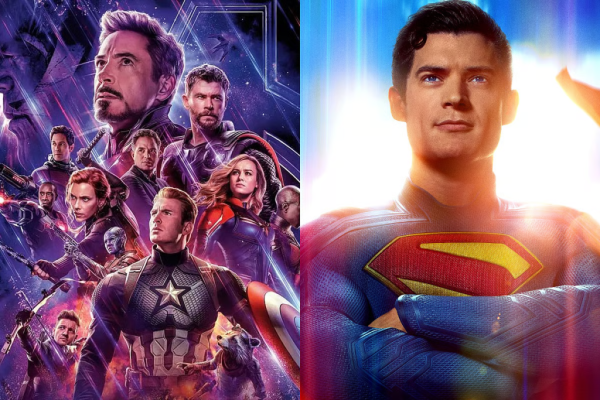
From Endgame to Superman: Inside Hollywood’s Reinvention of the Superhero Era
When Avengers: Endgame arrived in 2019, it represented more than another blockbuster. It was the culmination of more than a decade of interconnected storytelling and became a defining moment for the modern superhero movie. The film eventually grossed around $2.8 billion worldwide, setting a benchmark that Marvel and its rivals have struggled to replicate.
But the superhero landscape has changed dramatically since then. Audiences have become more selective, streaming has altered viewing habits, and the sheer volume of Marvel and DC content has contributed to what Hollywood increasingly describes as superhero fatigue.
Now, with James Gunn’s new DC Universe and Marvel’s push toward Avengers: Doomsday, Hollywood is attempting something different: not simply making more superhero movies, but reinventing how the genre works.
The post-Endgame problem
The MCU’s greatest strength before Endgame was its long-term continuity. Characters and storylines gradually converged, giving audiences a reason to follow multiple films over many years.
After Endgame, however, that formula became harder to sustain.
Marvel introduced new characters, expanded its television output and experimented heavily with the multiverse. Shows such as WandaVision, Loki and The Falcon and the Winter Soldier became increasingly connected to the wider MCU.
For some viewers, keeping up with the franchise began to feel less like entertainment and more like homework.
Marvel boss Kevin Feige has acknowledged the problem. According to industry analysis, Marvel produced roughly 51 hours of storytelling between 2007 and 2019, but released more than 100 hours in roughly half that amount of time afterward. The resulting increase in volume contributed to concerns about oversaturation and declining audience trust.
The era of superhero fatigue
The superhero genre itself has not disappeared. Instead, audiences appear to have become less willing to watch a superhero film simply because it carries a familiar logo.
Recent box-office trends illustrate the change. Superhero movies are no longer automatic billion-dollar attractions, and even major characters can struggle when audiences don’t see a compelling reason to return to the cinema.
Industry observers increasingly argue that viewers haven’t stopped liking superheroes—they have stopped accepting mediocre superhero movies.
That distinction is important.
The problem isn’t necessarily Superman, Batman, Spider-Man or the Avengers. The bigger challenge is convincing audiences that each new installment offers something worth experiencing on a big screen.
DC presses the reset button
Perhaps the clearest example of Hollywood’s reinvention strategy is DC.
Rather than continuing to expand the previous cinematic universe indefinitely, DC Studios, under James Gunn and Peter Safran, opted for a major reset.
The new era began theatrically with Superman in 2025, starring David Corenswet as Clark Kent/Superman. Gunn’s film was designed not merely as another reboot, but as the foundation for a new interconnected DC Universe.
The strategy was immediately tested at the box office.
Superman opened to an estimated $122 million in the U.S. and Canada and $217 million globally in its opening weekend.
Its success suggested that audiences could still embrace a superhero film when the character, tone and storytelling offered a fresh proposition.
But the subsequent performance of superhero projects has also demonstrated that one successful reboot cannot single-handedly restore the genre.
Marvel is changing its approach too
Marvel’s answer has been more complicated.
Instead of endlessly expanding the MCU, the studio has begun reducing its output and concentrating its biggest bets on major theatrical events.
That strategy is particularly visible in Avengers: Doomsday, which reunites the Russo brothers with Marvel and brings together an unusually large collection of characters, including the Avengers, Fantastic Four and X-Men.
Robert Downey Jr. is also returning to the MCU, but not as Tony Stark. He is playing the villain Doctor Doom, following Marvel’s decision to move away from the previously planned Kang storyline.
It is a striking example of Hollywood’s new approach: combine familiarity and nostalgia with a radically different character dynamic.
The multiverse became Hollywood’s nostalgia machine
The multiverse was initially presented as a storytelling tool capable of opening unlimited creative possibilities.
In practice, it also became a powerful nostalgia engine.
Spider-Man: No Way Home, for example, brought together different generations of Spider-Man characters, turning decades of superhero history into a single theatrical event.
That formula can work spectacularly—but it comes with a danger. If every major crossover depends on bringing back familiar actors and characters, audiences may eventually feel that the industry is recycling its own history.
The challenge for studios is therefore to use nostalgia as an ingredient rather than the entire meal.
Superheroes are becoming more character-driven
Another important shift is tonal.
The superhero movie of the late 2010s was frequently built around enormous CGI battles, interconnected plots and escalating stakes. The new generation increasingly has to offer stronger character motivation and a distinctive cinematic identity.
That may help explain why Gunn’s Superman connected with audiences. Rather than presenting the character solely as an invincible action hero, the film emphasized compassion, vulnerability and humanity. DC itself describes Gunn’s version as a Superman driven by compassion and belief in the goodness of people.
The broader lesson is straightforward: spectacle remains important, but spectacle alone is no longer enough.
Animation is another part of the reinvention
Hollywood’s superhero experiment is also extending beyond traditional live-action blockbusters.
Animated superhero films have demonstrated that audiences are willing to embrace radically different visual styles, storytelling structures and tones.
The success of projects such as Spider-Man: Into the Spider-Verse and its sequel helped demonstrate that comic-book adaptations don’t have to look or feel like conventional superhero movies.
Animation gives studios another way to refresh familiar characters without simply repeating the visual formula established by previous live-action franchises.
The audience has become the gatekeeper
Perhaps the biggest change since Endgame is that audiences have gained more power.
In the pre-Endgame era, being part of a major cinematic universe could be enough to guarantee enormous opening-weekend interest.
Today, viewers can wait.
They can decide whether a film is worth the theatrical ticket, whether they need to watch the previous installments and whether the latest entry offers anything genuinely new.
Recent industry results underline this shift: superhero movies can still become major hits, but they are no longer guaranteed successes merely because they feature famous comic-book characters.
What comes next?
Hollywood’s superhero era is not ending. It is evolving.
Marvel is attempting to restore event status to its biggest films. DC is rebuilding its universe around a new creative leadership structure. Studios are experimenting with animation, darker stories, comedy, horror influences and more self-contained narratives.
The central lesson from the post-Endgame period may be that bigger is not always better.
The next successful superhero era is unlikely to be built simply by adding more heroes, more universes and more crossover events. Instead, studios will have to give audiences a reason to care about individual stories again.
Endgame proved that interconnected superhero storytelling could become a global cultural phenomenon. Superman demonstrated that a familiar character could still generate excitement through reinvention.
The next chapter of superhero cinema will be determined by whether Hollywood can turn those lessons into a sustainable formula—one where audiences don’t feel obligated to follow a universe, but genuinely want to.
Contact to : xlf550402@gmail.com
Copyright © boyuanhulian 2020 - 2023. All Right Reserved.