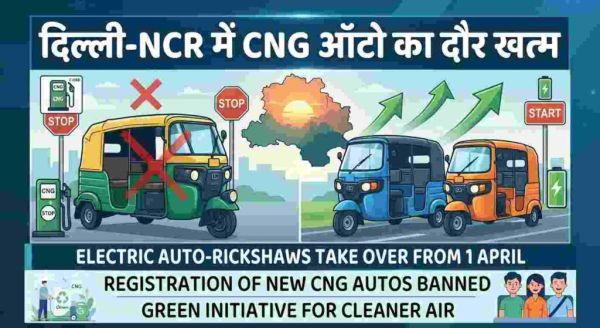
There is going to be a major policy change to deal with the problem of toxic air and air pollution that worsens every winter in the National Capital Region (Delhi-NCR). CNG was once promoted as the cleanest fuel for relief from pollution, but now a plan has been prepared to gradually end the era of CNG auto rickshaws in the capital and surrounding cities. Under the EV policies of the Commission for Air Quality Management (CAQM) and the Delhi Government, work has begun on a strategy to stop registration of new CNG autos and put only 100% electric autos (E-Autos) on the roads in the coming years. New registrations of CNG autos will be closed in a phased manner. According to the detailed roadmap prepared for pollution control, this change will not be implemented in one go but in a phased manner: Starting in Delhi: First of all, there is a preparation to completely ban the registration of new CNG auto rickshaws in the national capital Delhi, after which only new permits and registrations of e-autos will be issued. High Vehicle Density (HVD) districts: After Delhi, new registrations of CNG autos will be prohibited in the five busiest cities of NCR—Noida (Gautam Buddha Nagar), Ghaziabad, Gurugram, Faridabad and Sonipat. Rest of NCR region: In the next phase, the entire region will be connected to the e-mobility network by banning the registration of non-electric three-wheelers in the remaining districts of NCR (like Meerut, Panipat, Rohtak, Alwar etc.). Why is the government moving from CNG to e-auto? CNG emits less smoke than conventional petrol and diesel, but research by air quality experts and TERI has shown that CNG vehicles emit large amounts of nitrogen oxides (NOx). This nitrogen oxide reacts chemically in the atmosphere to form 'secondary particulate matter' (Secondary PM 2.5), which accounts for more than 25% of Delhi-NCR's winter smog. Moreover, even though the number of three-wheelers in the total vehicles in NCR is limited, their proportion in particulate matter emissions remains quite high due to intensive driving throughout the day and continuous fuel burning. Converting to a 100% e-auto fleet will directly reduce emissions of several tonnes of harmful particles every year. What will be the impact on existing CNG auto drivers and permits? The biggest confusion regarding this policy is whether all the existing CNG autos running on the roads will be immediately confiscated or stopped? According to the guidelines of the Transport Department and CAQM, this rule will mainly apply to the registration of new vehicles. Those CNG autos currently plying on the roads with valid permits and fitness certificates will continue to operate normally till their stipulated shelf life of 10 to 15 years. However, at the time of renewal of old autos which have completed 10 years, drivers will be motivated to upgrade or retrofit them to e-autos by providing attractive subsidies and scrappage incentives. Charging Infrastructure and Challenges for Auto Drivers Expansion of infrastructure is the biggest priority to make this widespread e-auto revolution successful. Charging and Battery Swapping Stations: A network of fast charging and battery swapping points is being rapidly established at major metro stations, bus terminals and auto stands in Delhi and NCR. Economic relief and lower operating costs: The running cost (cost per kilometre) of e-autos is much lower compared to the ever-increasing prices of CNG, which will increase the daily earnings of auto drivers in the long run. Subsidy and easy loans: Delhi government and respective states of NCR are providing facilities like single window system, exemption in road tax and loans at low interest rates for new e-auto buyers. This major change will not only make the public transport system of Delhi-NCR cool and modern in the coming years, but will also prove to be a decisive step towards providing clean air to crores of citizens.
Contact to : xlf550402@gmail.com
Copyright © boyuanhulian 2020 - 2023. All Right Reserved.