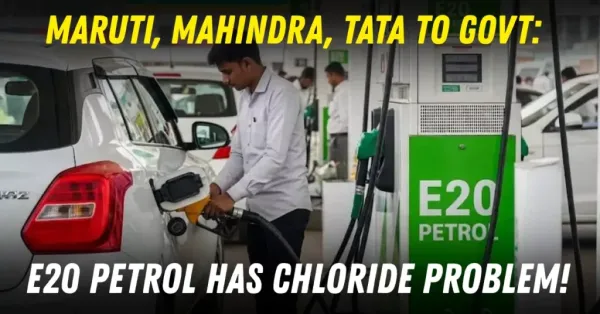
The E20 debate has taken a more serious turn. Reuters reports that internal industry emails and fuel-test data show that major carmakers had privately raised concerns about high chloride and moisture levels in petrol samples collected from fuel stations, even while the industry publicly supported the nationwide E20 rollout.
More than 250 samples were collected over roughly a year across 21 states and Union Territories. High chloride readings were recorded in samples from 18 states. Some results were dramatically above the government’s stated limit of 3 parts per million.
That does not prove ethanol itself caused the contamination. The concern is about the quality of fuel reaching vehicles after blending, transportation and storage. The government and state-owned fuel retailers strongly dispute that there is a widespread contamination problem.
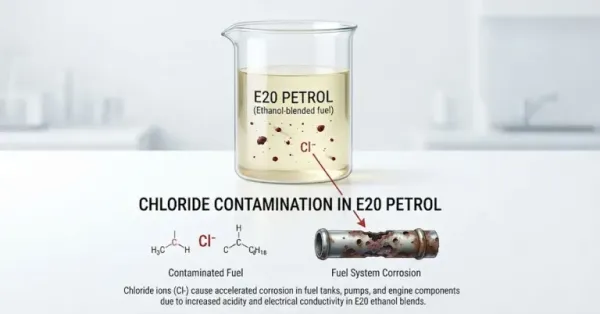
Industry tables circulated internally showed chloride levels ranging from 6 ppm to as high as 570 ppm in Rajasthan, up to 420 ppm in Delhi and up to 357 ppm in Maharashtra. Moisture readings reportedly reached 13,000 ppm in Andhra Pradesh and 12,500 ppm in Uttar Pradesh, against a benchmark of 3,000 ppm.
Those numbers matter because chloride can be corrosive to fuel-system components. One Maruti executive said current fuel injectors can tolerate a maximum chloride level of about 1 ppm.
A Mahindra fluids-technology engineer said internal evidence linked organic chloride contamination with rapid vehicle failures and warned that severe contamination could damage engines within a few hundred kilometres.
SIAM had written to the government on July 28 about contamination concerns, but later withdrew the communication, saying the testing basis and sample size were insufficient for definitive conclusions. That withdrawal is now important because the internal correspondence reviewed afterwards showed the carmakers had discussed the results in detail before the letter was sent.
The oil industry’s own data paints an almost opposite picture. State-run fuel retailers say nationwide testing found no reason for alarm.
More than 100 petrol samples tested at refineries reportedly showed chloride at or below 1 ppm. Ethanol samples from about 80 distilleries and E20 samples from more than 80 depots and terminals were also within prescribed limits. Inspections across the retail network found no widespread water ingress into underground tanks.
Petroleum Minister Hardeep Singh Puri has said only four contamination cases were identified during the recent testing drive.
Mahindra has also rejected the conclusion that its internal emails prove a broader E20 problem, calling the industry data limited and preliminary. SIAM says the information was meant for internal discussion and validation and that only a small number of carmakers contributed samples.
E20 can reduce fuel economy because ethanol contains less energy per litre than petrol, and older vehicles have raised compatibility questions because many were certified before E20 became the nationwide standard.
Contamination is a separate problem. A perfectly E20-compatible vehicle can still be damaged by contaminated fuel, regardless of whether the contaminant entered during production, transport or storage.
SIAM’s withdrawn letter itself pointed to underground storage tanks and pipelines at retail outlets as a possible source of excessive moisture. The root cause of the high chloride readings remains unresolved.
What motorists now need is repeated sampling from the same retail outlets, clear laboratory methods and public results explaining why industry and government tests produced such different findings. The industry’s data is large enough to justify further investigation, but even SIAM says it is not strong enough for a national conclusion.
E20 may ultimately prove un to the contamination itself. But if fuel quality at the pump varies enough to threaten injectors or engines, it’s a massive problem that needs urgent attention.
Contact to : xlf550402@gmail.com
Copyright © boyuanhulian 2020 - 2023. All Right Reserved.