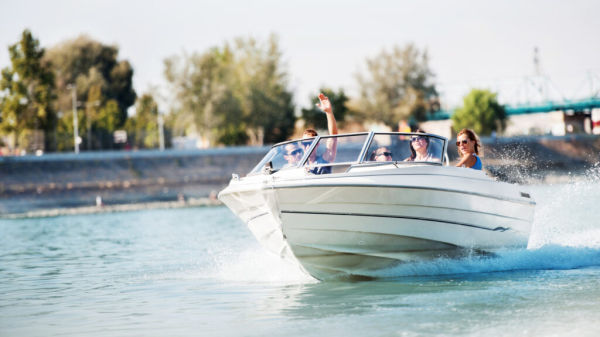
If you live near a coastline, river, or large lake, you’re probably more than familiar with the sound of engines rumbling as a speedboat tears up the water at high speed. This noise can be mildly annoying, but in the event it escalates to a full-on public nuisance, that wouldn’t just be irritating; it could also violate state or local law. Many U.S. states have strict laws on the levels of noise permissible by motorboats, with precise permitted decibel levels and specific laws varying depending on both the state in question and when a boat and its motor were manufactured. Local laws may also determine if other noise sources like music are factored into a boat’s overall volume level.
It’s typically advised that a motorboat operator keep the sound of their motor at a reasonable level, as having the engine and sound system too loud may make it hard to hear signals or voices around you. This is also why many states require motorboat engines to be equipped with a muffler or another effective sound-suppression system and prohibit modifying an engine exhaust with the express purpose of making it louder. You should generally endeavor to keep the noise down out on the water, both for your own safety and to avoid being a nuisance to locals, but you may also want to be aware of boat noise laws if you’re visiting from out of state and bringing your own boat with you.
Motorboat noise level laws vary by state
Jim Arbogast/Getty Images
The precise noise level that your boat would need to produce before you’re in trouble depends on a few factors, including whether the boat is stationary or in motion, the city and state you’re in, and when the engine on your boat or the boat itself was manufactured.
For example, in the state of Connecticut, any boat in motion cannot have its engine exceed a noise level of 75 decibels when measured from at least 50 feet away. If the boat is stationary, then its permissible noise level depends on when the engine was manufactured. If it was built before 1993, it can’t be louder than 90 decibels, and if it was built on or after January 1, 1993, that’s reduced to 88 decibels, both from 40 inches away. There are rules in place to permit certain kinds of valves that divert exhaust around the muffler, but this is only for extenuating circumstances.
The state of Minnesota’s laws, meanwhile, stipulate that engines built before 1982 cannot exceed 86 decibels at 4 feet while idle and 84 decibels at 50 feet in motion, while engines built on or after January 1, 1982, cannot exceed 84 decibels at 4 feet when idle and 82 decibels at 50 feet in motion. Additionally, it’s illegal to sell or operate a boat with a bypassed or altered muffler, which is a good reason to be careful when buying a used boat.
Incidentally, depending on local laws, decibel measurements may account for all sources of noise produced by the boat, including loud music. In New York City, for instance, citizens are allowed to file a complaint against a noisy boat based on the sound of its engine, the volume of the music it’s playing, or excessive horn blowing.