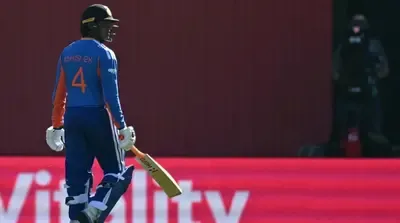
The recent T20I performances by India have been heavily criticised, following consecutive series defeats to Ireland and England. Following a 2-0 loss in Ireland, the 4-0 defeat in England has left many questioning whether this batting order can only score runs on barren surfaces.
This criticism is just and valid; however, "flat-track bullies" is a poor phrase to associate with this team based on what they have managed to do in the past two years.
This is also the same set of players that won away T20I series in Australia, South Africa, Sri Lanka and Zimbabwe, the same team that lifted the ICC T20 World Cup and the Asia Cup, all in an aggressive cricketing style. Should a couple of bad weeks forget those?
England Exposed India's Failure to Adapt
The real problem for India during the England tour was not their attacking mentality. It was their inability to adapt to conditions.
Having played on pitches at home where the ball was coming on nicely, all India were suddenly up against high-quality seam bowling on lively pitches in Ireland and England. They were continually asked tough questions by bowlers like Jofra Archer, Josh Tongue and Sam Curran, and they struggled to respond.
The third T20I collapse at 78 highlighted those issues, but the fifth game was a reminder that Indian batting still possessed plenty of firepower once the batters had stabilised.
Chasing 258, Ishan Kishan contributed 56 from 35 while Tilak Varma blasted 53 from 25 balls. Shreyas Iyer, the captain, scored a brisk 28, and Sanju Samson scored 27 in only 14 balls. However, India could not achieve long partnerships and fell short at 201/8.
Also Read | Wasim Jaffer Defends Shreyas Iyer After India's Series Losses in Ireland and England
Selection Changes Show Search for Answers
India also played the series with some changes in an effort to improve their results.
15-year-old Vaibhav Sooryavanshi was dropped after three failures in a row, as Sanju Samson made a comeback to the top order in the last T20I. The right-hander got himself off to a good start but failed to consolidate his good work into a match-winning score.
Despite falling short in the last game, Abhishek Sharma also had on-and-off days throughout the tour. He looked comfortable against the England pace attack in the first two games, but struggled to put on a good score in the next three. Shreyas Iyer had a good tour with the bat as the Indian skipper scored two half-centuries and piled up over 200 runs in the 5-match T20I series.
Samson, who had a miserable outing in the first game, was dropped for the next three T20Is, handing a debut to the young Sooryavanshi. Vaibhav, who has been amazing in the IPL, was expected to perform well in the internationals as well. However, with no experience in international men's cricket and a lack of experience playing in English conditions, he failed.
The other thing that brought complications for the Indian side was their batting order. Tilak Varma, who has done exceptionally well at no. 3 in the past was asked to bat at 5 or below.
Shivam Dube and Axar Patel also batted at different numbers throughout the series. It has been evident that most of the batters struggle to perform when shifted from their natural batting spot. And in formats like T20Is, batters don't have enough time to settle on the new position, which leads to inconsistency.
The Approach Should Stay, But Adaptation is Needed
India have enjoyed successes over the past two seasons utilising this assertive approach with the bat, which has also led them to hold the World Cup. With several white ball games ahead, India would be wise not to change their game plan markedly after one bad trip abroad.
The more important thing is that India needs to evolve much more quickly under pressure. The English bowlers have just pointed out technical and tactical flaws, not that the batting style has gone wrong.
However, the imminent T20I series against Zimbabwe is a chance for India to prove a point. The results in England were not up to the mark, but they should be taken as a wake-up call rather than a sign of a team that fails to adapt to conditions and changes its identity every time it encounters failure.
Contact to : xlf550402@gmail.com
Copyright © boyuanhulian 2020 - 2023. All Right Reserved.