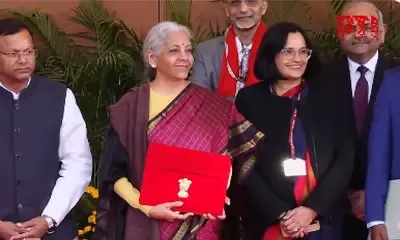
Budget Day is watched closely by millions of Indians for what it could mean for salaries, savings, taxes and household spending. Over the years, it has also become associated with Finance Minister Nirmala Sitharaman’s distinct style statement — her sarees.
When she presents the Union Budget, her attire often draws nearly as much attention as the economic announcements. Many viewers attempt to read meaning into the colours, borders and motifs she chooses. However, the most consistent theme has been her steady preference for Indian handloom and traditional crafts over mass-produced fashion.
Since taking charge as Finance Minister in 2019, Sitharaman has frequently worn sarees representing different states and weaving traditions. Observers say this has helped bring visibility to local artisans, rural livelihoods and small-scale textile industries, aligning with the broader push for “Vocal for Local”.
A steady focus on traditional weaves
Sitharaman’s first Budget presentation in 2019 set the pattern. She wore a pink Mangalagiri silk saree from Andhra Pradesh. That year also stood out for another symbolic shift — she carried the Budget documents in a red “bahi khata” instead of the colonial-era briefcase. The bahi khata is a traditional ledger long used by traders and small businesses across India.
In 2020, she chose a bright yellow-gold silk saree with green borders, a combination widely viewed as reflecting optimism and growth. In 2021, she wore a red-and-white Pochampally ikat saree from Telangana, known for its distinctive geometric patterns.
Her 2022 look featured a rusty brown Bomkai saree from Odisha, recognised for its detailed threadwork and rich craft legacy. In 2023, she opted for a red silk saree from Karnataka with black temple motifs and Kasuti embroidery — a style many associated with strength and stability.
For the interim Budget in early 2024, Sitharaman wore a blue Tussar silk saree with Kantha work from West Bengal. Later that year, during the full Budget presentation, she appeared in an off-white Mangalagiri saree with a purple border.
Regional identity and symbolism
In 2025, the Finance Minister wore a cream-coloured handloom silk saree featuring Madhubani art from Bihar. The saree was gifted by Padma Shri awardee Dulari Devi, who had requested Sitharaman to wear it on Budget Day. The hand-painted fish and floral designs attracted widespread attention, with many interpreting them as signs of prosperity and progress.
Sitharaman’s Budget Day sarees have come to be seen as a cultural statement, combining heritage, symbolism and subtle political messaging. This year too, the tradition continued. On Sunday, the Finance Minister wore a maroon kattam Kanchivaram saree featuring golden-brown checks and a coffee-brown border with intricate threadwork.
Over time, Sitharaman’s Budget Day sarees have become more than a fashion detail — they have emerged as a consistent reminder of India’s diverse weaving heritage and the livelihoods tied to it.
Contact to : xlf550402@gmail.com
Copyright © boyuanhulian 2020 - 2023. All Right Reserved.